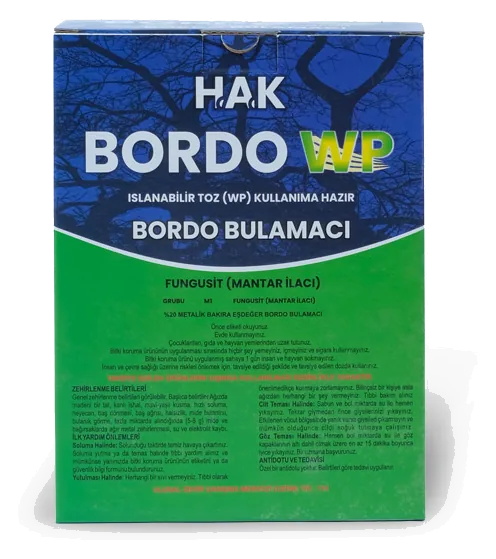
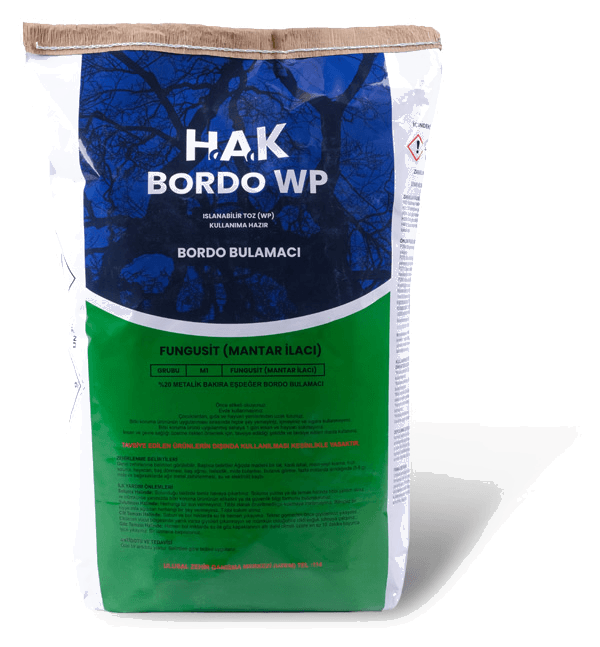
HAK Bordo WP is a Bordeaux mixture based on copper sulfate and hydrated lime, formulated as a wettable powder (WP).
It is a modern, practical form of the classic Bordeaux mixture, which is used in agriculture primarily as a preventive treatment against fungal and bacterial diseases.
It forms a protective layer on the surfaces of leaves, branches and trunks, preventing pathogens from attaching to the plant and spreading. Thanks to its dry, free-flowing structure, it is easy to prepare, disperses evenly in water and does not settle during application.
Specifications
Product type
Fungicide
Mode of action group
M:1
Active ingredient
Bordeaux mixture equivalent to 20% metallic copper
1st application: Apply when shoots reach 25-30 cm in length.
2nd and subsequent applications: Apply 15 days after the first application.
Taking into account meteorological factors such as the region's average daily temperature and rainfall, relative humidity and dew, apply when conditions favor infection and stop applications once these conditions no longer apply.
Dead arm (Phomopsis) in vineyards
Winter application: Apply after pruning, just before bud break.
Summer applications: Make the first application when shoots are 2-3 cm long, the second at 8-10 cm and the third when they reach 25-30 cm.
Apple scab
1st application: When the flower buds swell (3-5 days earlier where twig scab lesions are present).
2nd application: At the pink bud stage (when individual flowers become visible).
3rd application: When 70-80% of the petals have fallen.
4th and subsequent applications: Apply at 15-day intervals while weather conditions favor disease development.
Shot hole disease in stone fruits
1st application: In autumn, immediately after leaf fall.
2nd application: In spring, before the flower buds open (at the pink bud stage).
On apricots, make an additional third application at shuck split, when the calyx and stamens are being pushed off the tip of the young fruit.
Peach leaf curl
A single application is made when the buds begin to swell.
Olive peacock spot
Marmara Region: First application just before the autumn shoots appear; second application once the flower clusters have formed but before the flowers open.
Aegean Region: First application just before the spring shoots appear; second application once the flower clusters have formed but before the flowers open.
Mediterranean Region: First application after harvest, second just before the spring shoots appear, and third once the flower clusters have formed but before the flowers open.
Crop / Application area
Target
Dose
Note
Vineyard
Downy mildew (Plasmopara viticola)
500 g / 100 L water
Pre-harvest interval: 14 days
Vineyard
Dead arm (Phomopsis viticola)
Winter 3500 g, summer 500 g / 100 L water
Pre-harvest interval: 14 days
Apple
Scab (Venturia inaequalis)
1500 g / 100 L water
Pre-harvest interval: 14 days
Apricot
Shot hole (Wilsonomyces carpophilus)
Dormant season 1250 g, growing season 625 g / 100 L water
Pre-harvest interval: 14 days
Peach
Leaf curl (Taphrina deformans)
1500 g / 100 L water
Pre-harvest interval: 14 days
Olive
Peacock spot (Spilocaea oleaginea)
1st application 1500 g, 2nd application 1000 g / 100 L water
Pre-harvest interval: 14 days
Dosage and application details are subject to the official product label.
Product guidance.
Symptoms of poisoning
General symptoms of poisoning may occur. The main symptoms are a metallic taste in the mouth, bloody diarrhea, blue-green vomit, rapid breathing, agitation, dizziness, headache, weakness, nausea and blurred vision.
Ingestion of large amounts (5-8 g) causes heavy metal poisoning of the stomach and intestines, together with loss of water and electrolytes.
First aid measures
If inhaled: Move to fresh air. In case of inhalation, ingestion or contact, seek medical attention and, if possible, have the product label or safety data sheet with you.
If swallowed: Do not give any liquids and do not induce vomiting unless advised by medical personnel. Never give anything by mouth to an unconscious person. Seek medical care.
In case of skin contact: Wash immediately with soap and plenty of water. Wash contaminated clothing before reuse. If there are burns in the affected area, do not remove clothing and try to keep the skin as cool as possible.
In case of eye contact: Rinse with plenty of water for at least 15 minutes, including under the eyelids, and consult a specialist.
Antidote
There is no specific antidote; treat symptomatically.
Storage
When stored under normal (cool and dry) conditions in its original, tightly closed packaging, the product's physical, chemical and biological properties remain within tolerance limits for 2 years.
Resistance management
HAK Bordo WP is a fungicide classified as Group M:1 by mode of action. Repeated applications of products with the same mode of action promote the development of resistance.
To delay resistance, do not exceed the recommended total number of HAK Bordo WP applications within a single growing season. Where further applications are needed, use products with a different mode of action (other than Group M:1).
Compatibility
HAK Bordo WP should be used on its own and must not be tank-mixed with other plant protection products, including insecticides, fungicides and plant growth regulators.
Hazard statements (H)
H302: Harmful if swallowed.
H315: Causes skin irritation.
H318: Causes serious eye damage.
H319: Causes serious eye irritation.
H410: Very toxic to aquatic life with long lasting effects.
Precautionary statements (P)
P264: Wash thoroughly with water after handling.
P270: Do not eat, drink or smoke when using this product.
P271: Use only outdoors or in a well-ventilated area.
P280: Wear protective gloves, protective clothing, eye protection and face protection.
P310: Immediately call the National Poison Information Center (114) or a doctor.
P330: Rinse mouth.
P362: Take off contaminated clothing and wash it before reuse.
P501: Dispose of contents and container in accordance with the Waste Management Regulation.
EUH401: To avoid risks to human health and the environment, comply with the instructions for use.
Precautions for use and storage
Toxic to bees; do not apply during flowering.
Toxic to fish; do not contaminate any water source.
Keep the product tightly closed in its packaging and store in a cool place.
Do not leave the spray mixture in the sprayer for long periods.
Do not reuse packaging bags; dispose of them properly.
Manufacturer's statement
We guarantee the quality of our products. Our company accepts no liability for damage resulting from improper storage or misuse of plant protection products.